
West Africa · 80 min hands-on · 90 min waiting · Meat · Main course · For confident cooks
Egusi Soup
Original name: Egusi-Suppe
For 6 servings · US units
Nigerian stew of toasted melon seeds, palm oil, meat and fish
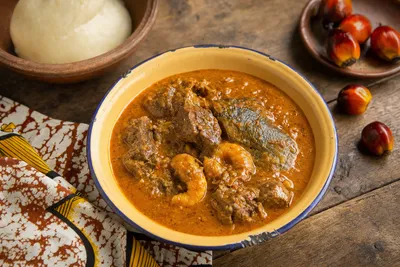
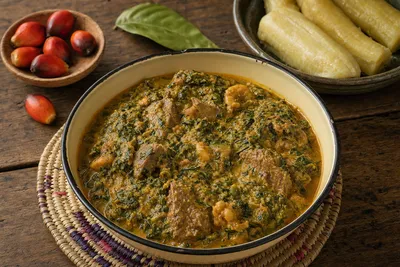
Egusi soup is a Nigerian, and more broadly West African, stew of ground melon seeds. Toasting the seeds in red palm oil gives the soup a nutty, slightly grainy body, while beef, stockfish and smoked fish add depth. It comes to the table with a starchy accompaniment such as eba, fufu or pounded yam, which is traditionally used to scoop up the soup by hand.
Ingredients
- 8¾ ozshelled, coarsely groundShelled, usually ground seeds of a West African gourd, used to thicken soups and stews and give them a mild, nutty flavour.Substitute: Hulled, unroasted pumpkin seeds, finely ground, come closest: they thicken in a similar way and also form clumps, but taste a little greener and stronger and tint the dish slightly green. Roasted or salted seeds do not work, and ground almonds or peanuts change both flavour and texture noticeably.Read more
- ½ cupunrefined; heat gently, do not let it smokeRed, unrefined oil pressed from the fruit of the oil palm; it stains food deep orange and tastes faintly nutty and earthy.Substitute: There is no good substitute: neutral oil with a little sweet paprika or annatto matches the colour but not the distinctive, slightly earthy flavour that defines many West African stews.Read more
- 1⅛ lbbeefstewing cut in large chunks; goat meat works as well
- 6⅓ ozsoaked, deboned, pulled into chunksCaution: Whole stockfish must be soaked for several days in cold water changed daily, depending on thickness, or it will stay hard and inedible even after long cooking.Unsalted cod or saithe dried in the open air until wood-hard; once soaked it turns firm and fibrous, with a strong, deep flavour.Substitute: The closest option is salt cod, which must be soaked thoroughly to remove the salt; it is milder and softer and carries less of the strong savoury flavour. Smoked fish adds depth but brings a smokiness stockfish does not have. There is no true equivalent.Read more
- 5¼ oze.g. catfish or mackerel; soaked, deboned, flakedFish, whole or in pieces, smoked and dried over a wood fire, usually catfish, mackerel or bonga. Hard, dry and intensely smoky, used more as a seasoning than as a main ingredient.Substitute: Hot-smoked mackerel from the chiller cabinet comes closest, but it is milder and softer; use more of it and add it towards the end so it does not fall apart completely. A little dried shrimp or ground crayfish can partly make up the missing depth, but neither substitute fully matches the pronounced wood smoke.Read more
- 8¾ ozshaki; cleaned, cut into strips (optional)Cleaned beef stomach, usually sold pre-cooked by butchers, in Turkish grocers (as işkembe) or frozen in Asian shops.Substitute: There is no true substitute, since the soft yet slightly rubbery texture is the point; beef cheek or shin gives a similarly slow-braised dish, but without that bite.Read more
- 4 tbspfor seasoningSmall smoked and dried crustaceans, finely ground, a strong, smoky and savoury seasoning in West African cooking.Substitute: Dried shrimp from an Asian shop, finely ground, come closest, but they lack the smokiness. A little smoked fish or a small pinch of smoked paprika makes up for some of it, though not the full flavour.Read more
- 2onionpartly for the broth, partly for the pepper base or to sauté
- 2or habanero; stems removed, adjust to heat preferenceCaution: The heat clings to the hands and burns eyes and mucous membranes, so wear gloves when cutting and add it sparingly.A small, squat, very hot chili with a fruity aroma, a close relative of the habanero.Substitute: Habanero comes closest in heat and fruitiness; milder chilies such as jalapeño bring neither the heat nor the aroma and leave the dish flat.Read more
- 1bell pepperseeded, for the blended base
- 2tomatoesroughly chopped, for the blended base
- 2stock cubefor the meat broth and the soup
- 3⅓ cupswaterfor cooking the meat; the broth goes into the soup
- 5¼ ozspinachor fluted pumpkin leaves (ugu) or bitter leaf; washed, finely shredded
- 1 tbspcrumbled, for depth of flavour (optional)Fermented seeds of the West African néré tree, soft and dark, with a strong, pungent smell and a deep, savoury flavour.Substitute: There is no true substitute. A little light miso or fermented black beans give a similar savoury depth, but not the distinctive, slightly funky fermented character of iru; the dish will taste smoother and less distinctly West African.Read more
- saltto taste
Method
- Prepare the fishSoak the stockfish and smoked fish, debone them carefully and pull them into bite-sized pieces.
- Cook the meat until tenderSimmer the beef in the water with half an onion, one stock cube and a little salt until tender, adding the beef tripe as well if you are using it. Lift out the meat and keep the broth for the soup.
- Blend the pepper baseBlend the red bell pepper, scotch bonnet peppers, tomatoes and one onion with a splash of water until smooth. Coarsely grind the egusi seeds if they are not already ground.
- Toast the egusi in palm oilHeat the palm oil gently in a large pot without letting it smoke, and if you like, sauté the remaining half onion, finely chopped, in it (otherwise add it to the blend). Add the ground egusi and toast, stirring constantly, until it turns yellowish and smells nutty.
- Add the broth graduallyStir in the meat broth a ladleful at a time until you have a thick, slightly lumpy mixture.
- Simmer the soup downAdd the blended pepper base, cover and simmer, stirring regularly, until the oil rises to the surface. If the soup becomes too thick, add a little water.
- Add meat, fish and seasoningAdd the ground dried crayfish, the second stock cube, the crumbled fermented locust beans if using, and the meat, tripe and fish. Let everything simmer briefly together and season with salt.
- Wilt in the spinachStir in the spinach and let it wilt for 2 to 5 minutes.
- Rest and serveLet the soup rest for a few minutes, then serve with eba, fufu or pounded yam.
Tips and variations
Bitter leaf, used instead of or alongside the spinach, is considered key to the authentic flavour; fluted pumpkin leaves (ugu) work too. Rather than toasting the egusi in oil, you can cook it directly in the broth until it sets and add the palm oil only at the end, or shape the ground seeds into small balls with a little water and drop them into the boiling soup. Chicken, goat, cow foot or smoked turkey can replace the beef, and to save time you can cook the meat the day before. To eat, tear off a piece of fufu, press a hollow into it with your thumb and use it to scoop up the soup.
Allergens
Contains: Fish, Crustaceans, schalentiere
May contain if you use the optional ingredients: Cereals containing gluten
Not every ingredient in this recipe has been checked, so nothing is promised as free from.
These notes follow from this recipe's ingredient list. Ready-made products and brands may contain further allergens — please check the packaging yourself.
Something not right?
This recipe was put together from independent sources and checked before publishing. Even so, a mistake can slip through — an amount that does not add up, a step that does not work as written. If you spot something, write to us: we will look into it and put it right.